Docs
A design-system-first page-builder toolkit. Strike the right balance for your site — make it easy for editors to create engagement while staying compliant.
Why Inka?
- Compliance and engagement, not a trade-off — you decide where the dial sits for each site, instead of choosing between locking editors down and letting the design system drift
- Design-system-first — components declare what they tolerate, so off-system output can't be produced
- Multi frontend, multi backend — Next.js, Nuxt.js, Astro, plus server-only stacks (PHP, Django, Rails, Laravel) via the server-render pattern; switch channels mid-edit
- AI under the same constraints — everyone's AI can build you a page; ours can't build one that breaks your design system
- Evidence, not just warnings — rules a machine can't decide go to the people who can, and the determination is recorded against that version of the content
- Quick to adopt — enable visual editing with simple HTML data attributes, no React or Vue required in your frontend
- A toolkit, not a CMS — good out of the box with zero configuration, extensible when you need more; open source and self-hostable
- Enterprise features — versioning, i18n, workflow, and automated content rules
Try the online demo
The fastest way to feel what Inka does is to log into the hosted demo and edit a real page against a real frontend.
Open <https://hydra.pretagov.com>, log in, then:
- Open user preferences (bottom-left).
- Pick one of the preset frontends, or paste in your own frontend URL.
- Edit any page — every change updates the live preview.
The default preset is a Nuxt.js frontend deployed as an SSG to demonstrate scale-to-zero editing on free hosting. An Astro example demonstrates the server-render pattern for static-first frameworks. See Build a frontend › Deployment patterns.
To run Inka locally against your own frontend, see the Run Locally section of the project README.
Typography - Page Title (H1, 48/56px)
This page has a sample of the typography available in the theme.
Text
The Text Block allows you to add text to a web page. The text can be formatted and structured in different ways (bold, headings, etc.).
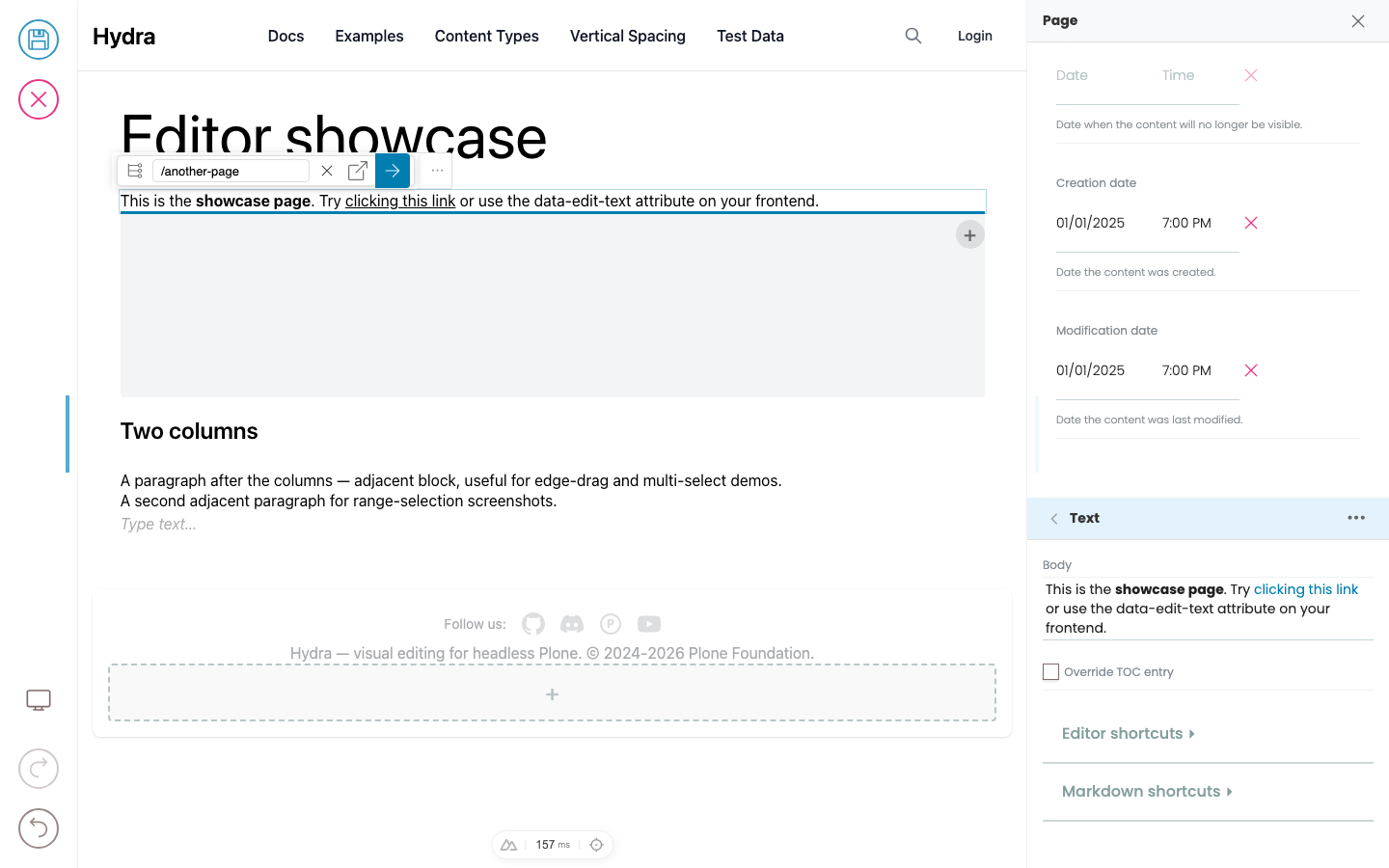
Table of Contents
The table of contents block automatically generates a table of contents with links to the corresponding positions on the page from the headings used.