Search
A search interface with faceted filtering. Contains a child listing block for results and typed facets (checkbox, select, date range, toggle) for filtering.
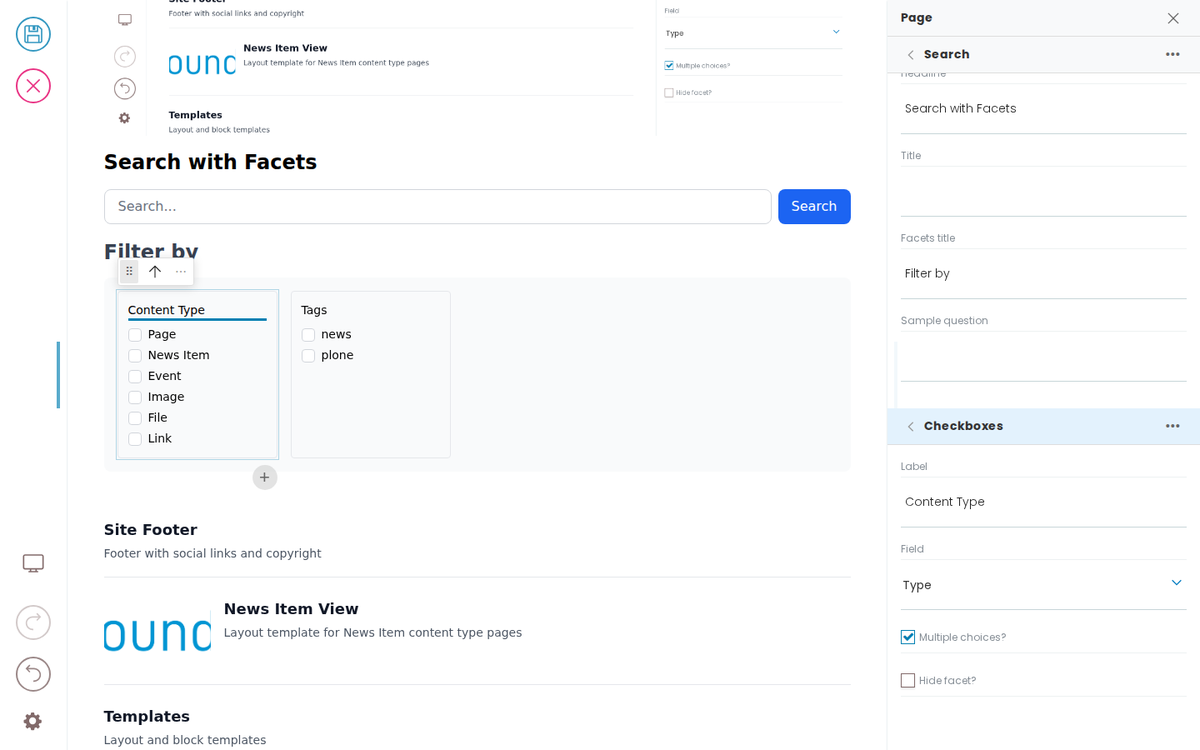
Search with Facets
Filter by
Custom Blocks
Define custom block types directly in your frontend configuration via the blocks option in initBridge. No editor plugin to deploy. Each block type needs an id, title, and a blockSchema with its field properties.
Installation
Get the Inka bridge into your project — prerequisites, getting and loading hydra.js, and the minimal initBridge() call that makes a page editable.
Listings & Dynamic Blocks
A listing block fetches content from the server (e.g. latest news) and renders each result as a separate block, repeating each block once per result entry. This means a listing can be moved between containers and reuse normal blocks for what it repeats.
Live Preview
To make your site editable with Inka you load hydra.js in your frontend and call initBridge(). This sets up a two-way communication channel that handles authentication, page navigation, and live content updates.
Multilingual sites
A multilingual site needs very little from a frontend. Render each language's tree as it comes, offer the page in the site's other languages, and the editor's translation tools work through the frontend you already have.
Server-rendered frontends
Inka works with any frontend, including ones that have no client-side
Simple Search
Docs
A design-system-first page-builder toolkit for any CMS. Guides for building a frontend, deploying and securing Inka, editing content, testing, adapters, and rules.
Templates
Layout and block templates
CMS adapter guide
Connect Inka to a content store through one adapter contract — the same experience for editors whatever sits behind it.
How Inka Works
Inka is the page-building and governance layer between your CMS and your front ends. Content stays in the CMS, rules come from your design system, and front ends in any framework render the result. Editing is private; publishing is public.
Rules and checks
The rules your front end sets are applied while people edit, from blocked saves to advice beside a field. Inka Assure, in development, will keep the record of what was checked and signed off.
Deploy and secure Inka
What to run, where to put it on your network, how editors' logins reach the front end, and the settings that keep editing private.
Developer Reference
Schema
Pass this object inside the blocks option when calling initBridge() to register this block type with the admin UI. See Custom Blocks for the full setup guide.
    search: {
        id: 'search',
        title: 'Search',
        group: 'common',
        blockSchema: {
            properties: {
                variation: { title: 'Variation' },
                query: { title: 'Query', widget: 'querystring' },
                listingBodyTemplate: { title: 'Results template' },
                showSearchInput: { title: 'Show search input', type: 'boolean' },
                showSortOn: { title: 'Show sort on', type: 'boolean' },
                showTotalResults: { title: 'Show total results', type: 'boolean' },
                sortOnOptions: { title: 'Sort on options', type: 'array' },
                facets: {
                  // Typed sub-items: each facet's `type` names its own block type,
                  // so the item is edited with THAT type's schema (the same shape
                  // slider.slides uses). A site can register another facet type and
                  // list it here without touching this schema.
                  title: 'Facets',
                  widget: 'object_list',
                  typeField: 'type',
                  allowedBlocks: ['checkboxFacet', 'selectFacet', 'daterangeFacet', 'toggleFacet'],
                  defaultBlockType: 'checkboxFacet',
                },
                headline: { title: 'Headline', type: 'string' },
                title: { title: 'Title', type: 'string' },
                facetsTitle: { title: 'Facets title', type: 'string' },
                // The quick-answer region only renders once a query has been
                // asked; the sample question is what data-block-selector-input
                // types to reveal it (query-reveal-page + query-reveal.spec).
                quickAnswerSample: { title: 'Sample question', type: 'string' },
                quickAnswer: {
                  title: 'Quick answer',
                  widget: 'blocks_layout',
                  allowedBlocks: ['quickAnswer'],
                },
                // The results region (docs/examples/search.md): a child listing
                // block under blocks_layout.listing. Undeclared, its children
                // render but never enter the pathMap — the exact orphan the
                // guardrail now refuses without exemptions. Mirrors the admin's
                // search schemaEnhancer (volto-hydra/src/index.js) EXACTLY —
                // that enhancer only adds the field when absent, so a diverging
                // fixture copy would win and change the sidebar.
                listing: {
                  title: 'Results Listing',
                  widget: 'blocks_layout',
                  description: 'Listing block to render search results',
                  allowedBlocks: ['listing', 'default', 'summary', 'teaser', 'image'],
                  maxLength: 1,
                  defaultBlockType: 'listing',
                },
            },
        },
    }
JSON Block Data
Example block JSON (as stored in the CMS). This is the data structure your component will receive in the block prop.
{
  "@type": "search",
  "headline": "Search with Facets",
  "listingBodyTemplate": "summary",
  "facetsTitle": "Filter by",
  "facets": [
    {
      "@id": "facet-type",
      "type": "checkboxFacet",
      "title": "Content Type",
      "field": {
        "value": "portal_type",
        "label": "Type"
      },
      "multiple": true,
      "hidden": false
    },
    {
      "@id": "facet-subject",
      "type": "checkboxFacet",
      "title": "Tags",
      "field": {
        "value": "Subject",
        "label": "Tags"
      },
      "multiple": true,
      "hidden": false
    }
  ],
  "blocks": {
    "listing-1": {
      "@type": "listing",
      "variation": "summary",
      "querystring": {
        "query": [
          {
            "i": "path",
            "o": "plone.app.querystring.operation.string.absolutePath",
            "v": "/"
          }
        ],
        "sort_on": "effective",
        "sort_order": "descending"
      }
    }
  },
  "blocks_layout": {
    "listing": [
      "listing-1"
    ]
  },
  "query": {
    "b_size": "4",
    "query": [
      {
        "i": "path",
        "o": "plone.app.querystring.operation.string.absolutePath",
        "v": "/"
      }
    ],
    "sort_on": "effective",
    "sort_order": "descending"
  },
  "showSearchInput": true,
  "showSortOn": true,
  "showTotalResults": true
}
Rendering
How this block renders in your frontend. Add its handling to your renderer, or — for list-style blocks — register a fetcher and reuse your list rendering.
function SearchBlock({ block, blockId }) {
  const [query, setQuery] = useState('');

  const facets = (block.facets || []).filter(f => !f.hidden);
  const listing = block.blocks_layout?.listing || [];
  const listingId = listing[0];
  const listingBlock = listingId ? (block.blocks?.[listingId]) : null;

  return (
    <div data-block-uid={blockId} className="search-block">
      {block.headline && <h2 data-edit-text="headline">{block.headline}</h2>}
      <input
        type="search"
        placeholder="Search..."
        value={query}
        onChange={e => setQuery(e.target.value)}
      />

      {facets.length > 0 && (
        <div className="facets">
          <h4 data-edit-text="facetsTitle">{block.facetsTitle || 'Filter'}</h4>
          {facets.map(facet => (
            <FacetRenderer key={facet['@id']} facet={facet} />
          ))}
        </div>
      )}

      {listingBlock && (
        <ListingBlock block={listingBlock} blockId={listingId} />
      )}
    </div>
  );
}

function FacetRenderer({ facet }) {
  switch (facet.type) {
    case 'checkboxFacet':
      return <fieldset data-block-uid={facet['@id']}><legend data-edit-text="title">{facet.title}</legend>{/* checkbox options */}</fieldset>;
    case 'selectFacet':
      return <label data-block-uid={facet['@id']}><span data-edit-text="title">{facet.title}</span><select>{/* options */}</select></label>;
    case 'daterangeFacet':
      return <label data-block-uid={facet['@id']}><span data-edit-text="title">{facet.title}</span><input type="date" /> – <input type="date" /></label>;
    case 'toggleFacet':
      return <label data-block-uid={facet['@id']}><input type="checkbox" /> <span data-edit-text="title">{facet.title}</span></label>;
    default:
      return null;
  }
}